On reverse thinking. Start from the thing as it finally stands, trace it back to whatever brought it into being, and the world turns into a museum.
Published
Reading time
5 min read
Topics
Philosophy, Product, Misata
A city, lit at night
Many hands, still in progress
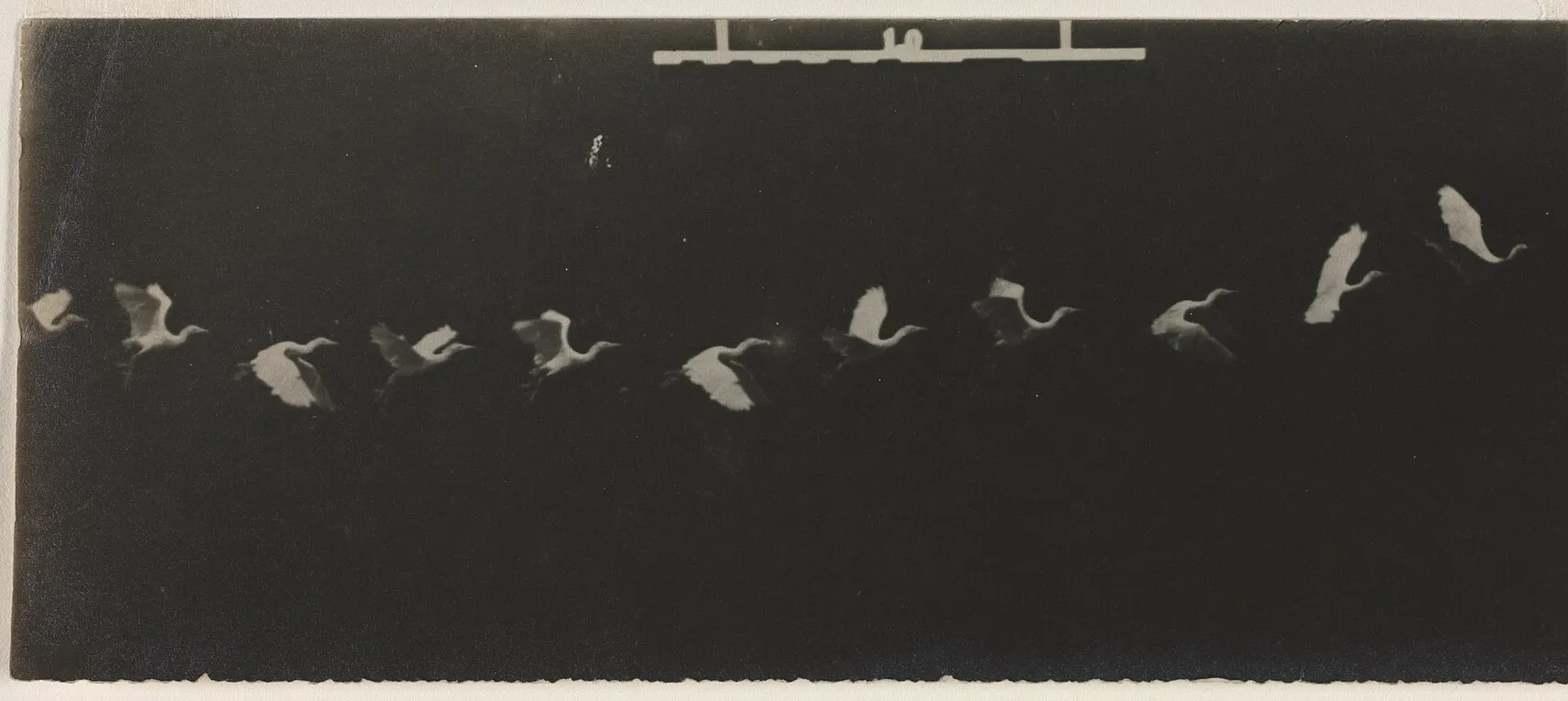
Flight of a heron
É.-J. Marey, 1880s
Misata
M. Rasin, 2025 to now
Nilavilakku
Kerala, kept for centuries
Untitled
Not yet made
Fig. 1. The museum of finished things.The last wall is still empty.
Loading…
I have recently become obsessed with a way of thinking that runs in reverse. You start from the outcome, the thing as it finally stands, and trace it back to whatever brought it into being. It is simply beautiful. Somewhere along the way the world turned into a museum for me, a museum of finished things, and I walk through it slowly, stopping in front of things that are already finished, a product, a city lit up at night, a tradition people have kept for centuries, and I can't help asking how each of them came to be the way it is. Every finished thing has a story standing quietly behind it, and once you learn to look for that story, nothing in the gallery is ever just an object again.
Every finished thing in this world is an exhibit, with the story of its making written somewhere behind the glass.
Room I · The first exhibit
For me it began with a project called Misata, and with a problem that made a few months of my life genuinely horrible. I needed synthetic data that behaved in very specific ways, and the tools I found worked in one direction only: give them real data and they would learn it and imitate it. I didn't have that data. What I had was a picture of the outcome, how the numbers should look once everything was in place, and no honest way of reaching it except trying, checking and trying again. Somewhere inside that frustration a simple thought arrived. Why can't we declare what the data's outcome should look like first, and then have the synthetic data generated in that manner?
That thought became Misata. You describe the result you want, revenue rising from one figure to another across a year or a fraud rate climbing quarter after quarter, and it builds every single row so that the whole adds up to exactly what you declared. In the language of product building, the acceptance criteria came first and the system was made to earn them. I believed I was solving a data problem. Looking back, I was being handed a new way of seeing.
Room II · Implanted intent
From then on I started looking at products and startups, at the way things are the way they are, almost entirely in this manner. Every landing page, every sales pitch, every line of copy began to show me the outcome it had been built backwards from. I developed an eye for implanted intent, the small arranged details placed there to produce an expected result quickly, and I picked up the knack fast because this is simply how so much of the world works. The people who understood it long before me wrote the books and became the wise ones. Amazon famously asks its teams to write the press release before the product exists.1 I was only arriving late to a gallery that had been open for a very long time.
Seeing the arrangement behind things is not always comfortable, because alongside the careful craft you also begin to notice the pieces designed to win quickly at the expense of whoever stands on the other side. That has shaped how I want to build. When I declare an outcome now, I want it to be one the person receiving it would be grateful for, something worth walking up to and standing in front of for a while.
Build the kind of outcome people would stop in front of, and be glad they did.
Room III · Watching birds
Fig. 2. A heron in flight, one bird exposed a dozen times on a single plate. Photographers and engineers spent decades studying the finished thing before anyone could build it.É.-J. Marey · Cleveland Museum of Art · CC0
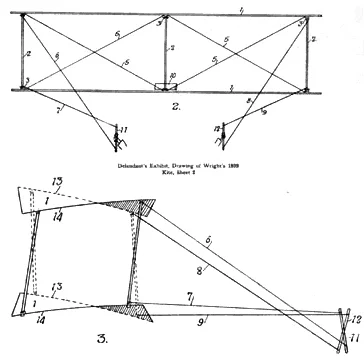
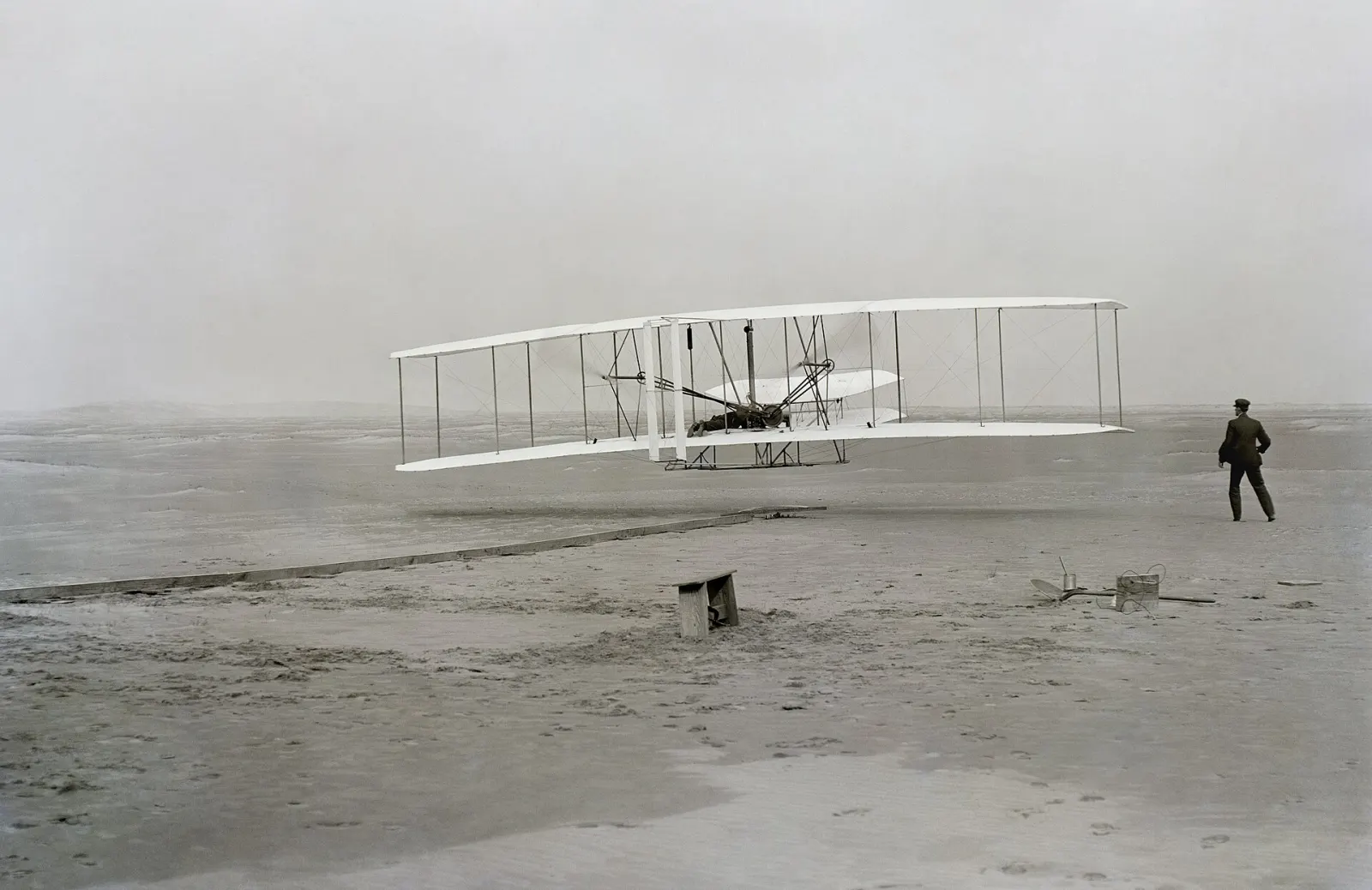
Flight eventually became possible for humans because we kept watching birds fly. The outcome hung there in the sky, complete and working, for thousands of years before anyone could build it. Many early attempts copied the bird's appearance, flapping wings and feathers strapped onto frames. The Wright brothers looked closer. Wilbur noticed how birds twist the tips of their wings to keep their balance, and from that one observation came wing-warping and the control that finally let their aircraft fly.2 They traced the finished thing back to its principle, and then built forward from there.
Fig. 3. The principle, drawn by Orville: the 1899 kite, with cords to twist its wings in flight. Later entered as evidence in the Wrights' patent cases.O. Wright · Library of Congress · Public domainFig. 4. Wing-warping. Twist the tips in opposite directions and one side meets the air at a steeper angle, lifts more, and the craft rolls. Wilbur took the idea from watching birds adjust their wingtips. Drag across the drawing, or use the slider.
The sky held the answer long before we knew how to ask the question.
I think imagination is that same outcome, carried inside us. It is what makes us pursue building things that were always supposed to be possible, because if not yet in reality, then in our minds, we have already built the results of the pursuits we are still walking towards. Every exhibit I admire in this museum of finished things was once only a picture in somebody's head, and that picture is what kept them walking long after the road stopped making sense.
Room IV · The wider angle
The other thing 2026 taught me sits right beside this one: to zoom out and look at things through a wider angle. Products, life, relationships, the happenings on this earth, the pursuits people give their years to. Up close, each one looks like its own separate piece in its own separate room. From further back you begin to see the patterns connecting them, the same few ideas repeating across rooms that seemed to have nothing in common. Builders know a small version of this feeling when they stop staring at one error and read through a whole week of logs, and the scattered failures quietly line up behind a single cause.
12 lines · 6 days
Mon 09:14errorcheckout: price mismatch on order 4411
Mon 17:52warnreport job retried (3 of 5)
Tue 08:03errorKeyError: 'vendor_id' in normaliser
Tue 11:40errorcheckout: price mismatch on order 4532
Wed 02:15warndisk usage at 81% on worker-2
Wed 09:22errordashboard: Q3 totals off by 3.1%
Wed 14:05errorKeyError: 'vendor_id' in normaliser
Thu 08:01warnslow query: invoices_by_month took 4.2s
Fri 09:47errorcheckout: price mismatch on order 4720
Fri 16:10warnTLS certificate renews in 12 days
Sat 03:00errornightly export: column count changed
Fig. 6. The wider angle. Up close, a dozen separate failures; from a week away, most of them trace back to one cause. An illustration, not a real incident.
Kierkegaard wrote that life can only be understood backwards, but must be lived forwards.3 Reverse thinking and the wider lens have become the two ways I read that sentence, first tracing each exhibit back to its making and then stepping back far enough to notice that the whole collection was arranged by a handful of the same ideas.
Room V · The empty walls
Together these two concepts have changed my outlook on this journey called life, remarkably. I still walk through the world mostly in awe, the way you walk through a museum for the very first time. What has changed is that I now notice the empty walls as well, the spaces where something hasn't been made yet, and I can't stop imagining what could hang there one day if we work towards it in the right ways. A museum of finished things is only ever finished for now. Every wall is waiting for whatever someone is still imagining, and some of those walls, I hope, are waiting for us.
Start from the outcome, and let it show you the way back.
reserved
Untitled
Not yet made. Medium to be decided.
If you are imagining something for one of these walls, I would love to hear about it.
Amazon's "working backwards" practice: a team drafts the press release and FAQ for a product before building it. Described at length in Colin Bryar and Bill Carr, Working Backwards (2021). ↩
Wilbur Wright watched birds regain their balance by twisting their wingtips, and in 1899 tested the idea on a kite whose wings could be warped from the ground. See wing warping. ↩
Søren Kierkegaard, journal entry of 1843: "It is perfectly true, as the philosophers say, that life must be understood backwards. But they forget the other proposition, that it must be lived forwards." ↩